
Choosing a chain for a non GamStop casinos payout
Choosing the right chain is the single decision that most changes the economics of a crypto cashout at a non gamstop casinos operator. The three variables are cost, speed and receiving-side compatibility. Our wider non gamstop casinos guide covers pending review and KYC, which apply to crypto too; this page focuses on what happens once the operator has released funds to the chain.
On cost, USDT on Tron sits at the low end (fees measured in cents). USDT on Polygon is close behind. BTC mainnet varies with block demand, from a few pounds to tens of pounds. ETH mainnet is the most expensive at times of network stress, occasionally running into three-figure pounds during peak periods. Layer-2 rollups (Optimism, Arbitrase, Base) can bring ETH-equivalent costs down significantly if the operator supports them, which most do not yet.
On speed, USDT on Tron and Polygon confirm in seconds. BTC mainnet averages 10 minutes per block and typically requires 3 to 6 confirmations to be treated as final. ETH mainnet confirms in around 15 seconds per block, with similar 3 to 6 requirements. Layer-2s are near-instant on their own network but still need bridging to mainnet if your receiving service does not accept the L2 directly.
On compatibility, the biggest risk is choosing a chain your receiving service does not accept. If your target is a UK-facing crypto exchange, check its supported networks list before requesting. USDT on Tron sent to an ERC-20-only address is unrecoverable. This is the single most common self-inflicted mistake on crypto cashouts and it can happen regardless of the operator.
Confirmations, block depth and finality
A confirmation is the inclusion of your transaction in a block that has itself been extended by subsequent blocks. The more blocks stacked on top of yours, the harder it becomes to reorganise the chain and reverse the transaction. Non gamstop casino operators typically treat a transaction as "sent" the moment it is broadcast; receiving services treat it as "usable" only after a threshold of confirmations.
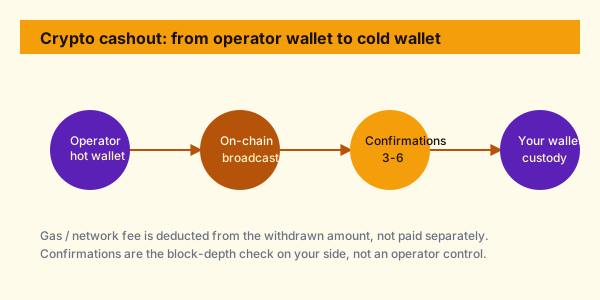
The typical confirmation requirements are:
| Chain | Confirmations required | Wall-clock time |
|---|---|---|
| Bitcoin mainnet | 3-6 confirmations | 30-90 minutes |
| Ethereum mainnet | 3-6 confirmations (some services more) | 1-3 minutes |
| USDT on Tron (TRC-20) | 19 confirmations (finality) | Under 1 minute |
| USDT on Polygon (PoS) | 128-256 confirmations | 4-8 minutes |
| USDT on Ethereum (ERC-20) | 3-6 confirmations | 1-3 minutes |
The number of confirmations required is set by the receiving service, not the sending operator or the chain itself. A cold wallet with default settings often has no explicit requirement — the moment the transaction is in the mempool, you can see it, and you can plan around it. An exchange has hard-coded thresholds you cannot change. Read your receiving service's rules before you request the cashout, not after.
Network fees and how they are deducted
The network fee — gas on Ethereum-family chains, mining fee on Bitcoin — is deducted from the withdrawn amount. The operator does not pay this fee for you. If you request £500 in USDT and the network fee is £2, you receive £498 worth of USDT in the receiving wallet. This is the standard behaviour across the entire crypto market; casinos do not deviate from it.
What operators do differ on is how the fee is presented in the cashier. Three patterns exist:
- Transparent — the fee is quoted in the cashier before you confirm, in the source currency. You see "£500 requested, £2 fee, £498 arriving".
- Silent — the fee is deducted from the withdrawal without being surfaced. You see "£500 requested" and receive £498. The £2 difference is the network fee.
- Approximate — the fee is estimated in the cashier but the final amount is trued up when the transaction is broadcast, because gas prices moved between click and confirmation.
For BTC and ETH, the fee is highly variable. Peak periods have historically pushed BTC fees over £15 for a standard transaction and ETH gas over £100 for token transfers. USDT on Tron and Polygon are the outliers on the low end and are the reason most players prefer them for casino cashouts.
Hot wallet, exchange and cold wallet targets
Your crypto cashout lands somewhere. There are three practical targets: a hot wallet (mobile app, browser extension), an exchange account, or a cold wallet (hardware device). Each has different tradeoffs for a casino payout.
The hot wallet is fastest for onward movement — you can trade or convert immediately — but it is the most exposed to phishing, malware and browser-based attacks. Never store material sums in a hot wallet for long; use it as a receiver, then move.
The exchange account is the most convenient path to GBP. Most UK-facing exchanges accept USDT deposits and let you sell for GBP within seconds, with withdrawal to a UK bank account via Faster Payments. The trade-off is that the exchange runs its own KYC, and depositing from an offshore casino wallet can occasionally raise a source-of-funds question at the exchange side.
The cold wallet is the safest long-term custody, but it is the slowest to redeploy. If you cash out to a cold wallet, expect to add a second transaction and second network fee any time you want to move the funds — treat the cashout amount as intended for medium-term storage, not spending.
Address entry, whitelisting and safe testing
A wrong-address crypto cashout is unrecoverable in almost every case. There is no equivalent of a chargeback or a bank recall. The transaction executes deterministically to the address in the transaction data, and if that address is wrong, the funds are gone.
Some operators implement address whitelisting: you nominate one or more addresses in your account settings, wait a short review period, and then can only withdraw to those addresses. This is a genuine security feature and worth using where available. It slows the initial cashout by a day but prevents an attacker from redirecting funds if your account is compromised.
The safe test pattern is: send a small first transaction to the target address, wait for confirmation, verify the balance in the target wallet, then proceed with a larger withdrawal. This costs one network fee — pence on USDT, a few pounds on BTC — and is the single best insurance against an address entry mistake.
The ordered checklist we run before every material crypto cashout:
- Confirm the operator supports the exact chain and token contract you intend to use.
- Confirm the receiving wallet or exchange supports the same chain, token contract and memo/tag convention if any.
- Copy the receiving address into the operator cashier and verify first-six and last-six characters against the source.
- If the operator supports whitelisting, whitelist the address and wait out the review period before the real cashout.
- Send a small test transaction, wait for the required confirmations at the receiving side, and confirm the balance.
- Only then submit the full amount, and keep the transaction hash for your records.
- After the final cashout confirms, remove the address from the whitelist if you do not plan to use it again.
USDT specifics: Tron, Polygon and ERC-20
USDT is the most common crypto cashout choice for UK players at non gamstop casinos because it does not carry the volatility of BTC or ETH. A £500 win withdrawn in USDT is £500 (minus fees and any spread) when it lands; a £500 win withdrawn in BTC is worth whatever BTC is worth by the time it arrives.
Tron (TRC-20) USDT is the cheapest and one of the fastest. Fees are sub-dollar, confirmations are under a minute. The tradeoff is that not every receiving service supports Tron, so check compatibility with your exchange or wallet before choosing.
Polygon USDT is similarly cheap, and Polygon has broader ecosystem support than Tron. Confirmations are a few minutes, fees are sub-dollar, and most major exchanges support it. This is our recommended default rail for medium-sized casino cashouts.
Ethereum (ERC-20) USDT is the most expensive of the three because you pay Ethereum gas on the transfer. It is worth using only when the receiving service supports nothing else. Fees can run into tens of pounds on a congested day.
Bitcoin payouts and network conditions
Bitcoin payouts are still supported at almost every crypto-friendly non-UKGC casino, but they carry the highest cost variability. Fees depend on block demand, which is out of your and the operator's control. Peak periods — around ordinal-inscription surges or high-fee events — have pushed a single transaction fee to £20 or more; quiet weeks bring it back under £1.
Speed is stable at roughly one block per ten minutes on average. Confirmation thresholds for spendable funds are typically 3 (fast receivers) to 6 (conservative exchanges), giving a 30-to-90-minute window in normal conditions.
If you cash out in BTC, three practical notes. First, request during a low-fee window if possible — mempool.space and similar dashboards show current conditions. Second, use the SegWit ("bc1") address type if the operator supports it, which lowers the effective fee. Third, be aware that BTC price movement between broadcast and confirmation can meaningfully change the GBP value of a small payout; do not treat BTC as a stable-value receiver for time-sensitive money.
Ethereum payouts and gas volatility
Ethereum mainnet payouts are less popular for casino cashouts because gas costs can be very high. A native ETH transfer costs less than a token (USDT-ERC-20) transfer; the difference can be 3x or more. For small payouts, the gas can consume a material percentage of the amount. Where ETH shines is smart-contract-based receiving flows — for example, cashing out directly into a DeFi position, though almost no casino supports this natively. For a standard consumer cashout, USDT on Polygon or Tron beats ETH mainnet on cost and matches it on speed. If ETH is the only option, request at a low-gas time (weekends and early UTC mornings tend to be quieter), use the operator's fee estimator if provided, and consider a Layer-2 rollup if the operator supports Optimism, Arbitrase, or Base. L2 fees are pence rather than pounds.
KYC on crypto cashouts and the source-of-funds question
Crypto does not exempt you from KYC. Non gamstop casino operators run the same identity checks on crypto cashouts as on fiat ones, and the pending review still applies before broadcast. For a first withdrawal, expect a full document pack.
Where crypto adds a wrinkle is the source-of-funds question at the receiving side. If you cash out to an exchange, the exchange may ask where the crypto came from as part of its own AML process. "Gambling winnings from a Curaçao-licensed operator" is a legitimate answer, but be prepared to provide the operator's confirmation email and a transaction record. Some exchanges may pause your account temporarily to satisfy this check, especially for larger amounts.
Cold-wallet destinations do not trigger this question because there is no counterparty asking. But when you later move funds from cold to an exchange to convert to GBP, the exchange runs the check then instead of now. The question does not go away; it is deferred to the disposal event.
UK tax treatment on crypto winnings and disposal
UK gambling winnings are not subject to income tax for individuals; this has been the case since 2001 and applies regardless of whether the operator is UKGC-licensed. If you win £5,000 in USDT and treat the USDT as the receiver of the winnings, that £5,000 is not taxable at the point of receipt.
However, subsequent disposal of the crypto can trigger Capital Gains Tax if the value has moved. USDT is a dollar-linked stablecoin, so most GBP-side movement comes from GBP/USD FX rather than USDT price change; the CGT exposure is usually small. BTC and ETH can move materially between receipt and disposal, and any gain on that movement is a CGT event.
This is a general information note, not tax advice. If you win a material sum via crypto cashout, keep the confirmation email, the transaction record and a value-at-receipt calculation, and consider talking to a UK accountant familiar with crypto. HMRC's guidance on crypto asset taxation is published on gov.uk and is updated periodically.
One further practical note. If you plan to cash out to an exchange and immediately sell to GBP, the spread the exchange charges is effectively an FX cost equivalent to the currency-conversion drag you would see on a card refund. It is often lower than the operator-side spread on a fiat withdrawal — typically 0.5 to 1 per cent at a competitive exchange versus 2 to 4 per cent embedded in an operator's card FX. For medium and large payouts this is one of the strongest arguments in favour of the crypto rail, provided you are already comfortable operating a wallet and a UK-facing exchange account.
Keep an eye on the exchange's own withdrawal timing to your UK bank. The winning path is: cash out from operator to exchange in USDT, convert to GBP inside the exchange, then Faster Payments to your UK bank. On a good day this whole chain completes inside two hours. On a slow day, an exchange-side compliance check can extend the last leg by 24 to 48 hours. Plan around the slow-day case and treat the fast case as a bonus rather than the norm.
Frequently Asked Questions
Which crypto is cheapest to cash out at a non GamStop casino?
USDT on Tron is typically the cheapest, with sub-dollar fees. USDT on Polygon is a close second. BTC and ETH mainnet cost more, especially at peak network times.
How many confirmations does a crypto cashout need?
Operators typically require 3 to 6 confirmations for BTC and ETH. USDT on Tron and Polygon are treated as final after a few blocks. Receiving services can set higher thresholds.
Does the operator pay the gas fee?
No. Gas or network fee is deducted from your withdrawn amount, not paid separately by the operator. This is standard crypto behaviour, not a casino-specific charge.
Can I withdraw crypto to a cold wallet?
Yes, though some operators require a hot-wallet or exchange address for the first withdrawal, then permit any address after account verification.
Is a wrong-address crypto withdrawal recoverable?
Almost never. Always test with a small transaction first, and always double-check the receiving address character by character. There is no chargeback route.
Are crypto cashouts subject to UK tax?
Gambling winnings are not subject to UK income tax for individuals. Selling the received crypto for GBP later may trigger Capital Gains Tax depending on the movement between receipt and disposal.
Responsible Gambling
GamStop is a legitimate consumer-protection scheme and this page is not an invitation to work around it. If you registered with GamStop to help control problem gambling, please respect the reasons that led you there. UK support is free: GamCare's National Gambling Helpline is 0808 8020 133, and GordonMoody, the NHS gambling clinics, BeGambleAware and GAM-Anon are all available. Text-mentioned only.
Crypto cashouts add a self-custody responsibility that fiat rails do not. Losing a seed phrase, mis-typing an address, or sending on the wrong chain are all common failure modes and no operator or regulator can restore lost funds. Take the additional care seriously. Regulatory background at Wikipedia — gambling in the United Kingdom; primary statute at Gambling Act 2005.

About the author
Daniel Whitaker — Withdrawal & Banking Reviewer.
Daniel focuses on cash-flow mechanics inside online gambling — deposit rails, withdrawal timing, and the friction consumers hit at payout — with fieldwork across offshore operators since 2018.