
The three legs of a non-UKGC cashout timeline
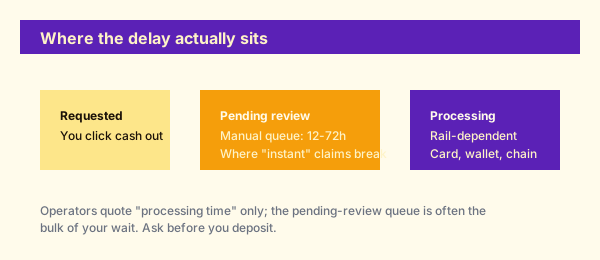
Every withdrawal at a non gamstop casino runs through three legs: pending review, operator processing, and the receiving-side clearing. If you take one message from our wider non gamstop casinos coverage, it is that the second leg — the one the operator advertises — is usually the shortest of the three. The pending leg is the biggest source of variance. The clearing leg is the most predictable but rarely instant. Reading the operator's SLA without understanding all three legs is how you end up complaining about a delay that was arithmetically inevitable.
Leg one is the pending review. Every reputable offshore operator holds cashouts in a queue for anti-money-laundering and fraud checks. The queue clears in batches, and its length varies with the day of the week and the operator's staffing model. Leg two is the operator's internal processing: the accounting entry, the payment authorisation and the release to the payment service provider (PSP). Leg three is the movement of money on the outside network: card refund settlement, wallet crediting, or on-chain confirmations for crypto.
Understanding the split matters because each leg has different levers. Leg one is affected by verification status, transaction size and operator staffing. Leg two is largely fixed by the operator's PSP contract. Leg three is entirely outside the operator's control — a card refund cannot be faster than the card network's settlement window, and a SEPA transfer cannot beat the SEPA calendar. If you understand which leg is dragging, you can plan around it, and you can push back on the operator only for the parts they actually control.
The pending-review leg in detail
The pending queue is where most of the variance lives. Typical shape: 12 to 72 hours during weekday hours, longer over weekends and bank holidays. The queue exists because a human reviewer is looking at every withdrawal above a small threshold, checking that the deposit source matches the withdrawal destination, that the account has not been flagged, and that no unresolved bonus or promotional term applies.
The queue length is a function of three variables. First, headcount: an operator with ten reviewers and a few thousand payouts a day can move faster than one with three reviewers. Second, batch size: some operators run three review windows a day; others run continuously. Third, prioritisation: some operators fast-track small withdrawals and hold larger ones for senior review, so a £200 payout may clear ahead of a £2,000 one submitted an hour earlier.
The single most useful data point about an operator is whether its terms use "up to X hours" or a flat "within X hours". Flat wording is usually marketing; "up to" language is honest and, in our reading, more trustworthy. Read the terms rather than the cashier text — the terms are the enforceable contract.
Debit-card refund timing
A debit-card withdrawal at a non gamstop casino is technically a refund on the deposit, not a fresh payment. It runs on the card network's refund rails — usually Visa Direct or Mastercard Send at faster operators, or classic ACH-style refund on older setups. The operator's step is fast: once the reviewer releases the payout, the PSP call to the network typically completes in minutes.
The clearing step is the slow one. Card refund settlement times are set by the card network and the issuing bank, and are commonly quoted as three to five business days. The 2020s modernisation of Visa Direct has cut this to a few hours on some issuer combinations, but that is not universal. UK challenger banks tend to clear faster than legacy high-street ones, which still batch overnight.
| Operator step | Network step | Typical UK arrival |
|---|---|---|
| Reviewer releases withdrawal | Refund initiated to card network | Same day |
| PSP submits to Visa Direct or equivalent | Settlement queued | Next business day (fast) to 5 business days (slow) |
| Refund arrives on card | Statement credit | 1-5 business days after PSP submit |
Two consumer notes. First, if you deposited from more than one card, the operator may split the refund across them — often mandated by AML rules that require withdrawal to a source used for deposit. Second, if your card was reissued or expired between deposit and withdrawal, the refund typically still lands correctly through the network's issuer mapping, but occasionally bounces and forces a bank-transfer fallback.
E-wallet payout timing
E-wallets are the fastest widely-available rail for non-crypto users. The typical wallets — Skrill, Neteller, MuchBetter, ecoPayz and a few Anjouan-oriented alternatives — settle credits in minutes to a few hours once the operator releases the payout. Their edge is that the wallet provider clears against the operator's PSP wallet directly, without a card-network settlement window.
Two nuances. First, the settlement is instant only if the wallet integration is native. Some operators show the wallet on the deposit path but route the withdrawal through a card partner, in which case the time defaults to card-network windows. Read the operator's own withdrawal method list and, if in doubt, ask support before depositing. Second, e-wallets impose their own limits and fees; those are set by the wallet, not the casino. Skrill and Neteller charge a percentage on some rails, and moving from wallet to bank account often adds another 24 to 72 hours if you use a bank transfer rather than instant card cash-out.
- Wallet to your bank via SEPA — 1 to 3 business days
- Wallet to your Visa Debit via instant transfer — minutes to hours (with a fee)
- Wallet to another wallet — near-instant, minimal fee
The clean pattern for UK players is: request from the operator to the wallet (near-instant once released), then let the wallet handle the wallet-to-bank leg overnight. That gets you sub-24-hour timing for most cases.
Bank-transfer timing (SEPA and SWIFT)
Bank transfers are the slowest legitimate rail. Non-UKGC operators typically use SEPA for EUR payouts and SWIFT for cross-border GBP or USD. SEPA settles within one to three business days on the standard scheme; SEPA Instant is technically 10 seconds but few offshore PSPs use it. SWIFT can take two to five business days depending on the intermediary banks in the chain.
The friction points on bank transfer are twofold. First, the receiving bank may pause the incoming payment for its own screening if the sending PSP is unfamiliar or is registered in a jurisdiction the bank treats as high-risk. That pause can add another 24 to 72 hours, and occasionally longer if additional information is requested. Second, if the operator sends EUR and your bank converts to GBP, the FX rate is the bank's card FX rate, which is typically less favourable than a multi-currency account.
The reason to use bank transfer is that it is the safest rail for very large payouts, because banks maintain audit trails and can produce the paper documentation many private-bank compliance teams want. For a £20,000 win, the extra three days is often worth the paper trail — but for a £500 payout, an e-wallet or crypto is almost always better.
Crypto rail timing and confirmations
Crypto payouts have the shortest external clearing window of any rail. Once broadcast to the network, a Bitcoin withdrawal typically confirms in 10 to 60 minutes, an Ethereum withdrawal in 1 to 10 minutes, and a USDT withdrawal on Tron or Polygon in seconds to a few minutes. The operator's step (release to broadcast) is normally within an hour of the reviewer's approval.
Confirmations are the block-depth checks that a receiving wallet or exchange requires before treating funds as spendable. A typical operator marks the payout complete on broadcast, but a receiving exchange may hold your deposit for 3 to 6 confirmations. For BTC that is roughly 30 to 90 minutes; for USDT on Tron it is minutes. Network congestion changes these numbers: during peak periods a BTC confirmation can queue longer, and gas fees on ETH can bite into small payouts.
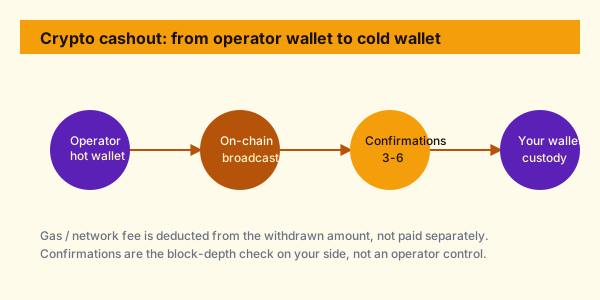
The pending-review leg still applies, sometimes fully and sometimes trimmed. Some operators shorten pending review for crypto for verified users on the theory that on-chain analytics give them a second signal. Others do not. Read the specific operator's terms rather than assuming crypto is unpolicied. Our dedicated crypto cashout page covers network selection and confirmation rules in more depth.
How KYC pauses the withdrawal clock
Every operator's SLA includes an implicit or explicit clause that pauses the clock during KYC. The moment a reviewer requests a document, the withdrawal is not "processing" in the SLA sense; it is "awaiting customer information", and the SLA re-starts once you upload. This is standard practice and is not itself a bad sign — but it changes how you should read timing complaints.
A typical KYC pause runs 24 to 72 hours from the moment the operator asks for a document to the moment they approve it. If the operator rejects the first document on marginal grounds (edges cropped, lighting insufficient) and asks for a re-upload, the clock re-starts again. In the worst honest case, a first-time verification can add a full working week to your cashout timeline.
The single most effective consumer counter-measure is to prepare the document pack before requesting the withdrawal. If you already have a good scan of your passport, a utility bill dated within the last 90 days, a card front-and-back photo and a selfie holding your ID, you can respond to any document request within minutes rather than days. That single change compresses the KYC pause by a full order of magnitude.
Weekday and time-of-day effect on the queue
The pending queue at most non gamstop casinos processes fastest during weekday European office hours, roughly 09:00 to 18:00 CET. Withdrawals submitted at 22:00 on a Friday almost always sit until Monday morning. Withdrawals submitted at 10:00 on a Tuesday typically clear within the same business day.
Payment-rail effects also vary by weekday. SEPA runs Monday to Friday; a Friday-evening release will settle Monday. Card refunds go through network settlement cycles that run 24/7 but with lower priority at weekends. Crypto is the only rail that treats a Saturday exactly the same as a Tuesday.
The ordered process to compress your total time is:
- Complete KYC upfront, before requesting any withdrawal, by uploading documents through the account portal.
- Submit the withdrawal request on Tuesday, Wednesday or Thursday morning European time.
- Choose the rail with the shortest clearing window that meets your amount — e-wallet or crypto for smaller sums, bank transfer for very large ones.
- Monitor your account for support requests once every four to six hours during business hours; respond promptly if documents are asked for.
- Do not initiate a second withdrawal until the first has landed, because concurrent withdrawals often trigger extra review.
Loyalty tier and queue priority
Some non-UKGC operators explicitly shorten pending review for higher loyalty tiers. The mechanism is queue priority: a VIP account's withdrawal jumps to the front of the review batch. The rail-level clearing time is unchanged — a card refund still takes as long as the network dictates — but the pending leg can compress from 24 hours to under 4. Loyalty priority is not always documented; it may be a soft feature of your account manager relationship. Priority does not remove KYC. A VIP account with incomplete verification hits exactly the same pause on the first cashout as a new sign-up. Do not choose an operator on the strength of promised VIP timing alone; the value of a VIP tier is usually in customer-service access rather than raw speed.
Reading an operator SLA honestly
The SLA published by a non gamstop casino is the enforceable timeline against which your withdrawal is measured. Read three things carefully. First, whether the number is "up to" or "within". Second, whether the SLA covers the entire timeline or just the operator's processing leg. Third, whether the terms explicitly state that KYC pauses the clock, and if so what "resolved" means for that pause.
A defensible SLA looks like: "Withdrawals are placed in pending review within one hour. Pending review is completed within 24 to 72 hours during business days. Processing is completed within one hour of pending clearance. Clearing to your account depends on your chosen method; typical windows are shown in the cashier."
An indefensible SLA looks like: "We aim to process withdrawals as quickly as possible." No numbers, no legs, no method breakdown. If that is the operator's language, you have no contract you can hold them to. Choose accordingly.
Frequently Asked Questions
What is the fastest withdrawal method at a non GamStop casino?
USDT on Tron or Polygon is the fastest end-to-end. Crypto still queues through pending review but confirmations complete in minutes rather than days.
Why does the operator quote 24 hours but it takes five days?
The quoted number covers processing only. Pending review adds 12 to 72 hours, and banking rails add another 1 to 5 days on top.
Are non GamStop casinos slower than UKGC-licensed sites?
On average, yes. UKGC sites carry heavier compliance staffing so pending queues clear faster. Rails themselves are broadly similar.
Does the withdrawal clock pause during KYC review?
Yes. From the moment the operator asks for a document, the SLA clock pauses until you upload and the reviewer accepts it.
Do e-wallets always beat card withdrawals?
Usually. E-wallets settle in minutes to hours; card refunds run on network settlement cycles which take several business days.
Can I request faster withdrawal by upgrading loyalty tier?
Some operators shorten pending review for VIP tiers. The rail time itself does not change; only the internal queue priority does.
Responsible Gambling
GamStop is a legitimate consumer-protection scheme. If you registered with it to control problem gambling, this page is not a workaround; it describes how offshore operators handle money for adults evaluating that market. Please respect the reasons you self-excluded.
UK support is free and confidential. GamCare's National Gambling Helpline is 0808 8020 133, 24 hours a day. GordonMoody offers residential treatment. The NHS operates specialist gambling clinics. BeGambleAware funds many of these services. GAM-Anon supports affected friends and family. Text-mentioned only; please look them up if you need them.
General background on the UK regulatory model is available at Wikipedia — gambling in the United Kingdom and the primary statute at Gambling Act 2005.

About the author
Daniel Whitaker — Withdrawal & Banking Reviewer.
Daniel focuses on cash-flow mechanics inside online gambling — deposit rails, withdrawal timing, and the friction consumers hit at payout — with fieldwork across offshore operators since 2018.