
What "instant" actually means at non GamStop casinos
"Instant" is a marketing term. No regulator defines what it means at a non gamstop casino, and no consumer standard requires an operator to time an "instant" claim end-to-end. For a general primer on the non-UKGC market see non gamstop casinos. In practice, "instant" describes the operator's own processing step only. The pending-review queue, the KYC pause and the receiving rail all sit outside the label, but they all still consume real time.
The honest reading of the word is: "our internal accounting step is fast, once the withdrawal has been approved". That step is often near-instantaneous — a database update and an API call to the PSP. What is not instant, and never can be, is the human review, the anti-money-laundering check, or the settlement of the outside rail. A fair operator uses "instant" alongside a total-time window that includes those legs; a marketing-heavy operator uses "instant" and leaves the rest for you to discover in the terms.
The consumer implication is simple. Treat "instant" the way you would treat "delivery in 2 hours" from a shop that then adds "subject to warehouse pick and courier availability". It is not a lie, but it is not the number you should plan around either.
The anatomy of an "instant" claim in a cashier
Look at a cashier and you will typically see three timing labels: "instant", "up to X hours", or "1-3 business days". "Instant" almost always sits next to specific methods — usually native e-wallets and crypto — and almost always excludes card refund and bank transfer. Behind the label is a PSP integration that supports the rail-level speed the operator is promising.
Four moving parts sit under the label. First, the operator's PSP contract with the wallet or chain provider must support fast settlement — not all do, and legacy setups often route through slower intermediaries. Second, the operator's own risk engine has to permit the withdrawal to skip additional review. Third, your account must be verified to the level required for the instant path. Fourth, the amount must sit within the tier that the operator is willing to release instantly, typically a lower threshold than for card or bank rails.
| Cashier label | Operator step | External settlement | Typical total (verified account) |
|---|---|---|---|
| Instant (crypto) | Minutes | Seconds to 1 hour (confirmations) | Minutes to a few hours |
| Instant (e-wallet) | Minutes | Minutes to 1 hour | Under 2 hours |
| Fast (card) | Minutes | 1-3 business days | 1-3 business days |
| Standard (bank transfer) | Same day | 1-5 business days | 3-7 business days |
E-wallet instant windows: the real numbers
Native e-wallet payouts are the closest a non-crypto user gets to genuine instant. On operators with proper Skrill, Neteller, MuchBetter or ecoPayz integrations, the wallet balance updates within minutes of the operator's release. The bottleneck is not the rail; it is the pending queue that sits before the release.
Real-world numbers from a verified account with completed KYC:
- Withdrawal requested at 10:00 CET Tuesday, reviewer clears at 10:12, wallet credited at 10:14. Total: 14 minutes.
- Withdrawal requested at 22:00 CET Friday, reviewer clears at 09:30 Monday, wallet credited at 09:33. Total: about 60 hours.
- Withdrawal requested at 14:00 CET Wednesday but flagged for enhanced review at 14:22, cleared 09:00 Thursday, wallet credited at 09:04. Total: 19 hours.
Two of the three examples above sit under the "instant" label the operator advertised, and only one of them delivered anything resembling instant end-to-end. This is the standard behaviour of the label across the offshore market. Do not read it as fraudulent; do read it as incomplete.
Crypto near-instant and the confirmation gap
Crypto is the rail that comes closest to living up to the "instant" label, because the external settlement step really can complete in seconds. USDT on Tron is the most extreme case: fees are tiny, confirmations are a few seconds, and a withdrawn amount is spendable in your receiving wallet almost immediately after the operator broadcasts.
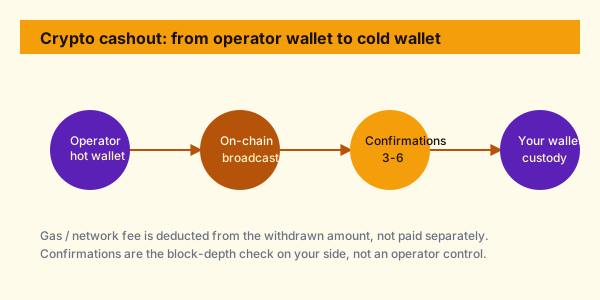
The confirmation gap is worth being precise about. When the operator marks the transaction as "sent", the blockchain has received the broadcast but not yet included it in a confirmed block. A receiving exchange or wallet may require 3 to 6 confirmations before treating the funds as spendable. On Bitcoin, that is roughly 30 to 90 minutes. On USDT via Tron or Polygon, it is a matter of seconds to minutes. On Ethereum, it depends on network congestion.
The pending queue still applies. Operators that advertise "instant crypto" typically mean that the outside rail is instant, not that the pending review is skipped. Some VIP setups do bypass or shorten pending review for verified crypto users; that is worth asking about explicitly if the timing of your first big withdrawal matters. For deeper coverage see our crypto cashout page.
Where "instant card refund" comes from and why it rarely delivers
Some operators list "instant" on card refund. This is technically supported by Visa Direct and Mastercard Send, which can push a refund to a card within 30 minutes on compatible issuer combinations. In practice, the label is almost always overpromising, because the receiving bank must accept and clear the credit on its own timetable.
UK banks vary widely. Some modern challenger banks credit Visa Direct payments in minutes. Some legacy issuers still batch overnight. Building societies often take longer still. The operator has no visibility into which side you are on, so the "instant" label is essentially a best-case marketing claim rather than a service-level commitment.
Two consumer notes. First, the debit-card refund path is regulated in ways that neither the wallet nor the crypto path is: your card issuer has full audit and chargeback machinery around it, which is a mixed blessing but is worth valuing for very large payouts. Second, if the "instant" card option fails or bounces, the fallback path is usually a bank transfer, which is much slower. Have a rail-level Plan B in mind before you request.
Pending review versus the instant promise
The instant label describes what happens after pending review. Pending review is the operator's holding step, and it is not covered by the label at all. That is the single largest source of confusion around instant claims. A player sees "instant" and assumes the total path is instant; the operator sees "instant" and considers only the leg after release.
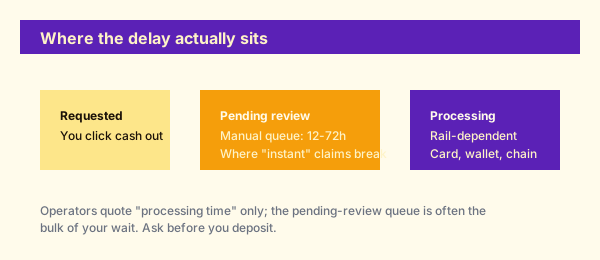
Pending windows for "instant" rails are shorter on average than for card or bank rails, because the operator's fraud engine gives higher confidence to verified users on those methods. But shorter is not zero. Expect 15 minutes to 8 hours during weekday hours, and full weekend waits if you time it badly. Some operators guarantee sub-hour review for VIP tiers on crypto and native wallets; those guarantees are worth writing down and holding the operator to.
Why the first cashout is almost never instant
Your first withdrawal at any non-UKGC operator is very unlikely to be instant regardless of method. The reason is delayed KYC: the first cashout triggers identity verification, and the review of your document pack cannot be automated in the same way that a repeat withdrawal to a known method can be.
The clean pattern to follow is:
- Complete KYC before any withdrawal by uploading through the account portal.
- Once verified, request a small test withdrawal — say £50 to £200 — to confirm the rail actually delivers within the operator's SLA.
- Note the timing end-to-end and only then plan larger cashouts based on that reference.
- Keep the test-withdrawal confirmation email as a paper trail against future SLA disputes.
This upfront test costs you a small fee and one PSP round-trip, but it is the single change that most reliably prevents an expensive surprise on a large win.
How to test an instant claim before staking real money
The test itself is straightforward. Deposit the smallest sum the cashier permits — often £10 or £20. Wager it once at a low-house-edge game (bet the whole balance on a small round of blackjack or a single sensible spin) to clear any deposit lock. Then withdraw the remaining balance via the rail marked "instant" and time the process.
Record five data points:
- Time of withdrawal request (down to the minute).
- Time your account status changes from "pending review" to "processing".
- Time the operator marks the transaction "sent".
- Time the funds appear as pending in your receiving account.
- Time the funds are spendable.
The first-to-third gap is the pending window. The third-to-fifth gap is the outside rail. Together they give you a realistic total to plan around for future, larger withdrawals. If any of the five data points cannot be identified because the operator's UI is opaque, that itself is a data point about how well-run the operator is.
Red flags in instant-withdrawal marketing
Some marketing patterns correlate with instant claims that do not hold up. Watch for:
- "Instant" used without any qualifier and without a specific method attached.
- "Instant" claimed on card refund with no reference to Visa Direct or Mastercard Send.
- Countdown timers on the cashier promising "money in your account in the next X minutes" — these are UX gimmicks, not commitments.
- Landing pages that advertise instant while the terms and conditions describe "up to 72 hours".
- Support chat that treats a question about total-time as a hostile enquiry.
None of these prove bad faith, but combinations of two or more are worth taking seriously. An operator that consistently overpromises on timing is an operator whose SLA cannot be relied on when it matters — which is usually the day of your biggest win.
Operator tiers and how instant labels differ
Not every non gamstop casino claiming instant withdrawal is describing the same thing. The market splits roughly into three tiers, and it is worth recognising which one you are on before you take the label at face value.
The top tier is a handful of operators that have invested in a proper always-on payout desk and native rail integrations. On these sites, "instant" is close to accurate for verified users on the eligible rails: sub-hour end-to-end on e-wallets and near-real-time on USDT. These operators typically also publish the pending-window as a separate, honest number rather than folding it into the marketing.
The middle tier is the bulk of the market. Instant labels are attached to the same eligible rails, but pending review runs on a weekday-heavy staffing model and the total time varies significantly. Median cases are still same-day; edge cases are two or three days, especially over weekends. These operators are not lying, but they are relying on the reader to understand that "instant" refers to a leg rather than the whole path.
The bottom tier attaches the instant label to almost everything, including rails that structurally cannot be instant. This is the group where the marketing outruns the plumbing. Signs are: instant claimed on bank transfer, instant claimed without any completed-KYC prerequisite, and total-time targets in the terms that contradict the instant label completely. Avoid this tier for material sums.
The way to identify tier without watching a payout live is to compare the language used across three surfaces: the marketing landing page, the cashier at withdrawal, and the terms and conditions. Consistent language across all three is a top-tier operator. Consistent language on two of three is middle-tier. Consistent language on none of the three is bottom-tier — a strong hint to move on.
Reading the terms behind the label
The terms and conditions are the enforceable contract. The cashier is marketing copy. When they disagree, the terms win in any dispute. Before depositing at any operator that advertises instant withdrawal, open the terms and search for three phrases: "processing time", "pending", and "review". Read every clause that contains any of them.
The gap between the marketing headline and the terms language is a reliable proxy for how much you should trust the operator's numbers overall. Small gaps mean the marketing team is on a short leash. Large gaps mean the marketing team is running the show and compliance is trying to catch up. You know which you would rather deal with when a payout matters.
One final habit is worth building. Save a dated screenshot of the exact "instant" claim on the cashier and landing page at the moment you deposit. Operators update these pages continuously, and if a dispute over timing arises weeks later, the current wording may not match what you were shown. A pair of screenshots costs you 30 seconds and gives you evidence that supports any subsequent escalation to the licensor. It is the cheapest form of consumer self-defence available on the offshore market, and no reasonable operator objects to a customer keeping their own records.
Frequently Asked Questions
Are non GamStop casino instant withdrawals actually instant?
Rarely end-to-end. The operator step can be instant on paper but pending review, KYC and clearing usually add hours or days.
Which methods come closest to instant?
USDT on Tron or Polygon, and native e-wallet integrations, are the closest. Total windows measured in minutes to hours on a verified account.
Does instant withdrawal apply on the first cashout?
Very rarely. The first cashout usually triggers KYC, and any instant claim is subordinated to that verification step.
Is instant a legal or marketing term?
Purely marketing. No regulator defines a standard. Read the operator's terms, not the marketing copy on the cashier or landing page.
Can I be charged for using the instant option?
Sometimes. Some operators surface a small fee for expedited rails; others build the cost into the FX spread. Check both.
What is the safest way to test an instant claim?
Deposit a small amount, wager to clear any lock, request a small first withdrawal and time it end-to-end before committing more.
Responsible Gambling
GamStop is a legitimate self-exclusion register. If you registered with it, the friction is the tool doing its job — please do not undo it. If you are worried about your play, help is free and confidential in the UK: GamCare's National Gambling Helpline is 0808 8020 133, and GordonMoody, the NHS gambling clinics and BeGambleAware are all available. Text-mentioned only.
Consumer warning: at non-UKGC operators there is no UK dispute recourse, KYC is still triggered at withdrawal, and unlicensed-platform deposits may not be recoverable. Weigh those risks carefully. For background see Wikipedia — gambling in the United Kingdom and the Gambling Act 2005.

About the author
Daniel Whitaker — Withdrawal & Banking Reviewer.
Daniel focuses on cash-flow mechanics inside online gambling — deposit rails, withdrawal timing, and the friction consumers hit at payout — with fieldwork across offshore operators since 2018.